Wednesday, October 19, 2022

Global Concerns in the Cold War Part II

Hello readers! It's been a while since I last posted an update here on the blog. Since my last post, I submitted my second manuscript to The History Press, which is super exciting, and I've been teaching. The last post was a long one, and this one is probably going to be a longer one as well, so let's dive in!


Emerging Nations

After WWII, many former colonies gained their independence. The US and the Soviet Union soon were engaged in a competition to win allies among the new nations.

The Soviet Union made a major effort to win support among the newly independent nations. To counter this appeal, President John F. Kennedy in 1961 proposed that Congress establish a Peace Corps. The new program sought to build friendships between Americans and the people of other nations. It also sought to encourage economic growth in developing countries. Thousands of Americans, young and old, volunteered to serve in poor villages in Asia, Africa, and Latin America; they shared their skills and knowledge as teachers, doctors, nurses, carpenters, and farmers.
 

Developments in Africa

The Soviet Union quickly extended aid to the new African nations of Ghana and Guinea. To counter Soviet influence, the US expanded its own aid to other newly independent countries. 

The Congo became a flashpoint for this competition between the US and the Soviet Union to gain influence in a region. In 1960, the former Belgian Congo gained independence as the nation of Congo. Soon, opposing groups were fighting over control of the new country. The US backed one side; the Soviet Union backed the other; both sides supplied airplanes, trucks, and technical advisers to its Congo allies…the fight for control became increasingly violent but in 1965 the Congo became independently controlled and called itself the Democratic Republic of the Congo.


The Philippines

With European nations weakened by WWII, many Asians saw an opportunity to seize the independence they longed for. The first Asian country to win independence in the postwar period was the Philippine Islands. The US had promised the Philippines independence in 1934; in 1946, the US lived up to its promise.

Unrest soon developed in the Philippines. Many Filipinos wanted reforms, especially land reforms. When the government moved too slowly toward making changes, fighting broke out. Some of the rebels were Communists; but in 1954 the government had defeated the rebels and made some of the needed land reforms.

After Ferdinand Marcos became president in 1965, however, the government became less democratic. In the years that followed, many groups continued to push for greater reforms.

On May 10, 2022 Ferdinand Marcos Jr. was elected the president of the Philippines. 


Indochina

Indochina, which had been under French control, took a different path. After WWII, France struggled to maintain control. In one of the colonies, Vietnam, Ho Chi Minh led the fight for independence from France. Because Ho Chi Minh was a Communist who had Soviet backing, the US backed the French. In 1954, Ho Chi Minh’s forces defeated the French and won control of the northern part of Vietnam. Fighting in Vietnam would last for almost 30 years. Before it ended, the fighting would draw the US into a long and bitter war.

But we’re not quite there yet…and this deserves its own series of posts.


Latin America and the Cold War

In the 1950s, the Cold War moved close to the US, in Latin America. The nations of Latin America faced many critical problems, including widespread poverty and poor health care. The US hoped that moderate Latin American governments would gradually improve these conditions…but instead many anti-American groups rose to power, including one that was close to our southern border—Cuba. 

In January 1959, Fidel Castro, a Communist, led a successful revolution in Cuba, overthrowing the president that the US had helped to place in power and supported. The Soviet Union promised Castro aid. Castro also began to encourage revolution in other parts of Latin America. Castro’s actions forced thousands of Cubans into exile, and many came to live in the US. In April 1961, a group of Cuban exiles secretly trained by the US CIA landed at the Bay of Pigs on the southern coast of Cuba. The Bay of Pigs Invasion failed and made Castro more popular in Cuba.

The next crisis with Cuba was more serious. Called the Cuban Missile Crisis, in 1962 aerial photographs showed American leaders that the Soviets were building nuclear missile bases inside Cuba. The bases could be used to launch missiles against the US.

President Kennedy insisted that the Soviet Premier Nikita Khrushchev remove the missiles, calling them a “threat to world peace”. Khrushchev refused, and Kennedy ordered the US Navy to blockade Cuba, preventing Soviet ships from bringing missiles to Cuba. For 13 days, the world held its breath as Soviet ships sailed to Cuba loaded with missiles…but at the last minute, the Soviet ships turned around. Khrushchev agreed to remove the missiles as long as the US promised not to invade Cuba.


In our next post, or series of posts, we're going to learn about the Vietnam Conflict.

Monday, August 15, 2022

Global Concerns in the Cold War, Part I

Hello readers! It's been a few weeks since I last posted an update here on the blog. I've been busy with work and putting lesson plans together for the upcoming school year, but I'm back so let's get right into it!


Tensions between the US and Communist nations increased during and after the Korean War. As the Cold War intensified, the US and the Soviet Union competed for power around the world. They engaged in a dangerous competition to build up their supplies of nuclear weapons–which would lead to the creation of the intercontinental ballistic missile, or ICBM for short.


The Arms Race

After almost 30 years of totalitarian rule in the Soviet Union, Josef Stalin died in 1953. His death brought no letup in the Cold War tensions. A new Soviet Union, Nikita Khrushchev, predicted that communism would destroy the Western democracies. By the end of the 1950s, the US and the Soviet Union had emerged as world superpowers. Superpowers are countries whose military, economic, and political strength are so great that they can influence events worldwide.

In the 1950s, the two nations began an expensive and dangerous arms race. An arms race is a contest in which nations compete to build more and more powerful weapons. In 1952, Americans exploded the first hydrogen bomb, or H-bomb. Soon, the Soviets had their own H-bomb. China joined the race by exploding its own atomic bomb in 1964; three years later, China exploded an H-bomb. Britain and France also developed nuclear weapons.

No country wanted to use nuclear weapons and risk a deadly counterattack. Instead, the nuclear nations stockpiled, or collected, their nuclear weapons. By the 1970s, the Soviet Union and the US had enough weapons stockpiled to destroy each other many times over. This idea of a deadly counterattack if one nation uses their nuclear weapons is call mutually assured destruction.

With the superpowers having stockpiled nuclear weapons, the US entered the Atomic Age. And as a result of the Atomic Age, everyday life in the US changed…similar to how students today have lockdown drills and fire drills at school, everyone had to be prepared for the possibility of nuclear war and there were “duck and cover” drills that people had to know; also, the ways Americans purchased products was affected because of the arms race and the Cold War.


Shopping Mall Fallout

After the successful launch of the Soviet nuclear bomb, Americans sought ways to protect themselves and their families, and turned to bomb shelters; some of these bomb shelters were underground, similar to steel-and-concrete reinforced foxholes, while others were inconspicuous public places such as schools and hospitals. As America was growing increasingly prosperous with its new status as a major industrial complex and a global superpower, families experienced an increase in disposable income. This meant that more people would be shopping for pleasure rather than necessity. Enter the American shopping mall! Now, this is information that I had posted in a previous blog post and have also shared on "The Half-Pint Historian Podcast", so bear with me if you've seen this content from me before, but for those of you who haven't, this is some information that is sure to get you thinking!

The first shopping mall in America was designed by Victor Gruen, who had immigrated to the United States from Austria in 1938 to escape Nazi persecution. He was an architect and would design many small shops and boutiques in the U.S.; he would also design the first shopping mall and it would opened in Edina, Minnesota in 1956, and the mall, the Southdale Mall, would be commissioned by the Dayton family, the owners of Target. Gruen's shopping malls were designed to be self-contained downtown centers where any Americans could spend their leisure time, but with the devastation that nuclear weapons were capable of, and the Cold War being in full-swing at the time he was designing the first mall and several others to come, Gruen also wanted shopping malls to act as nuclear fallout shelters.

Obtaining advice from numerous civil defense contractors, the Southdale Mall, and the others Gruen would design, would have features similar to shopping malls we see today—food courts, ample water fountains and restroom access, locking gates on store entrances, stores facing one another, numerous entrances and exits and even "hidden" hallways and access points, a central arboretum with real plants, at least two anchor stores, and other features. However, the most important feature in nearly all shopping malls in the U.S. as a result of World War II, which is still a major feature today, is where the mall is located—ten miles away from the city centers; if a hydrogen bomb were to be dropped on the major cities in any given state, those outside its eight-mile blast radius would survive. Malls tend to be outside the city centers so if a nuclear strike does occur, the people inside the malls at the time would survive the strike.

The idea of shopping malls operating as nuclear fallout shelters never really became popular, but it is interesting to think about the effects of World War II and the Cold War on our lives even today. Other places that do operate as public emergency shelters typically include: schools, fire departments, police departments, corrections facilities, town halls, and sometimes even shopping malls.

Along with the arms race, and the creation of the shopping mall, the Cold War era also saw the space race, where the US and the Soviet Union competed for dominance in the final frontier.


The Space Race

The Space Race began in 1955 when both countries announced that they would soon be launching satellites into orbit. The Soviets took the US announcement as a challenge and even established a commission whose goal was to beat the US in putting a satellite into space.

On October 4, 1957 the Russians placed the first successful satellite into orbit. It was called Sputnik I. The Russians had taken the lead in the Space Race. The Americans successfully launched their first satellite four months later called the Explorer I. The Soviets again won the race for putting the first man into space. On April 12, 1961 Yuri Gagarin was the first man to orbit the Earth in the spacecraft Vostok I. Three weeks later the US launched the Freedom 7 and astronaut Alan Shepherd became the first American in space. Shepherd's craft did not orbit the Earth, however. It was nearly a year later on February 20, 1962 when the first American, John Glenn, orbited the Earth on the Friendship 7 spacecraft.

The Americans were embarrassed at being behind the Space Race. In 1961 President Kennedy went to congress and announced that he wanted to be the first to put a man on the Moon. He felt this was important for the country and the western world. The Apollo Moon program was launched.

In conjunction with the Apollo program the US launched the Gemini program which would develop technology for use on the Apollo spacecraft. Under the Gemini program the Americans learned how to change the orbit of a spacecraft, spent significant time in orbit to learn how the human body would be affected, brought two spacecraft together in a rendezvous in space, and also went on the first space walks outside of a spacecraft.

After many years of experiments, test flights, and training the Apollo 11 spacecraft was launched into space on July 16, 1969. The crew included astronauts Neil Armstrong, Buzz Aldrin, and Michael Collins. The trip to the Moon took three days.

Upon arriving Neil Armstrong and Buzz Aldrin moved to the Lunar module, called the Eagle, and began their descent to the Moon. There were some malfunctions and Armstrong had to land the module manually. On July 20, 1969 the Eagle landed on the Moon. Neil Armstrong stepped outside and became the first man to walk on the Moon. With his first step on the Moon, Armstrong said "That's one small step for man, one giant leap for mankind".

With the Gemini and Apollo programs the US had taken a huge lead in the Space Race. In July of 1975 with relations between the US and the Soviet Union beginning to thaw, the first US-Soviet joint mission occurred with the Apollo-Soyez project. The Space Race was effectively over.

It was because of the Space Race that the National Aeronautics and Space Association, NASA, was founded as a part of the National Defense Education Act, with the goal of producing more rocket scientists and teachers.


Star Trek

Science fiction had been popular for quite some time in the US and the advances in technology during the years of the Space Race helped boost its popularity.

“Star Trek” aired from 1966 to 1969. Created by Gene Roddenberry and produced by Desilu Productions (owned by Lucille Ball and Desi Arnez), “Star Trek” is set in the years 2266-2269 and shows the voyages of the crew of the Starship Enterprise, NCC-1701. Roddenberry created the show to rival other sci-fi shows of the time, such as “Buck Rogers” and others. But “Star Trek” was unique as it boasted a multi-racial and multi-ethnic cast, showing Roddenberry’s ideal world where everyone, even green-blooded aliens from other galaxies, was created equal.

The show was unsuccessful at first and failed to gain advertisers’ attention. But after the original series went off the air, the show became popular in syndication. Roddenberry’s ideal world sparked interest from people of all ages for its storylines and the messages in the episodes. Today, there are a total of 12 television shows and 13 movies. Other TV shows and movies have even taken elements from "Star Trek" and incorporated those elements, or have been so inspired by the franchise that the newer product looks nearly identical (a great example of this is "The Orville" with Seth MacFarlane).

The show imagined a humanity so exceptional it had reached out to the stars: a great interplanetary alliance called the Federation, a union of planets that represented all Roddenberry believed human civilization could achieve. But the episodes were full of cautionary tales of science warped by hubris: Artificial intelligence run amok, weapons of mass destruction, computers that ruled entire civilizations. Only through a fierce commitment to human independence and ingenuity were the heroes of the Enterprise generally able to emerge victorious. This was Cold War allegory at its finest: technology could lead us down the path to destruction if in the wrong hands, but if combined with a belief in the individual human spirit it could take us to the stars.


This was a longer post, so be sure to be on the lookout for part two, where I'll be examining struggles happening in emerging nations.

Saturday, July 9, 2022

McCarthyism and the Second Red Scare

Hello everyone! It's been a bit since my last post; I've been busy with the last few days of school (I'm a middle school teacher, for any readers who didn't know), recording for season two of "The Half-Pint Historian Podcast", I started a part-time job for the summer which will turn into working nights and weekends during the school year, I've been lesson planning for the upcoming school year in September, and I've just been experiencing life in general. In any case, let's pick up where we left off!


American confidence was shaken by the Soviet possession of an atomic bomb, and the failure to win a decisive victory in the long stalemate in Korea further worried Americans. Due to these, American fears were realized at home.

Americans had absorbed a number of blows during the Cold War. Soviet possession of atomic weapons, the fall of China to the Communists, and the stalemate in Korea all led to worries about the ability of the US to defeat communism. Many Americans worried that Communist sympathizers and spies might be secretly working to overthrow the US government.

Two cases at this time seized public attention. In the first case, Alger Hiss, a former State Department official, was accused of passing government secrets to Soviet agents. Hiss’s accuser, Whittaker Chambers, had been a Communist during the 1930s. In 1948, Chambers appeared before a committee of the House of Representatives where he claimed that in the 1930s Hiss had given him top secret papers to pass to the Soviet Union. Hiss strongly denied passing any secret papers to the Soviet Union and sued Chambers for making false accusations. Then, Chambers produced copies of the papers. They became known as the “pumpkin papers” because Chambers had hidden them on microfilm in a pumpkin in his garden. So many years had passed that Hiss couldn’t remember the crime he committed and because it had been so long, Hiss couldn’t be charged with spying; he was, however, charged with perjury (lying under oath) to the congressional committee and spent several years in prison.

Fears about America’s security rose even higher in 1950 when several Americans were arrested on charges of passing the secret of the atomic bomb to the Soviets. In the most famous trial of the times, a married couple, Julius and Ethel Rosenberg, were found guilty of supplying information to the Soviet Union. They were sentenced to death. A worldwide outcry arose, but the Rosenbergs were executed in 1953.

Today, more than half a century after the trials of Alger Hiss and the Rosenbergs, their roles are still debated. However, many questions of their involvement have been resolved. In the 1990s, the US government released copies of secret Soviet messages that had been decoded after years of dedicated work. The messages appeared to show that both Alger Hiss and Julius Rosenberg had in fact spied for the Soviets; Ethel apparently was aware of the spying and may even have assisted her husband.


McCarthyism

A climate of fear contributed to the rise of Senator Joseph McCarthy of Wisconsin. McCarthy built his career by threatening to expose Communists. In a speech in Wheeling, West Virginia, in February 1950, McCarthy waved a paper in the air and claimed it contained the names of 205 Communists who worked in the State Department…McCarthy later reduced this number of 81, then to 57.

McCarthy refused to show the list to anyone. He didn’t even need to do so because many Americans were eager to believe him. His dramatic charges gained him a large following. During the next four years, McCarthy’s charges became more sensational; he led Senate hearings in which he bullied witnesses and made exaggerated charges. Eventually, the term McCarthyism came to mean accusing someone of disloyalty without having any evidence.

One of the things McCarthy is best known for was the establishment of the House Un-American Activities Committee (HUAC) which was dedicated, in theory, to finding American Communists in government, show business, and other fields. The committee hearings in 1947 resulted in many people being blacklisted, or denied work in their chosen fields, based solely on suspicions. One group of producers, directors, screenwriters, and actors–known as the Hollywood Ten–refused to testify before the committee. They were sentenced to jail time for their silence and many never worked in Hollywood again after their release. One writer, Dalton Trumbo, got around the blacklist by writing a screenplay under a pseudonym. He won an Academy Award for the screenplay, The Brave One, in 1956.

Aware of McCarthy’s power to destroy careers, few people were brave enough to oppose him and his “red scare” tactics. McCarthy finally lost his following in 1954 when a TV audience of millions saw him make false accusations against the US Army. Many Americans came to realize that McCarthy couldn’t support the charges. Soon after, the US Senate voted to censure, or condemn him. McCarthy died three years later. By that time, the Communist scare was mostly finished.


Next time here on the blog, we're going to examine global concerns in the Cold War.

Sunday, June 12, 2022

The Korean War

Hello readers! Rather than writing a lengthy intro, we're just going to jump right into things.


At the outset of the Cold War, the US used political and economic means to battle against Communism. However, the Cold War suddenly turned hot in the East Asian nation of Korea. As American soldiers fought in the Korean War, other Americans hunted for Communists in America.


Conflict in Korea

In 1910, Japan occupied the Korean Peninsula and ruled it harshly. After Japan’s defeat in WWII, Korea was divided at the 38th Parallel line of latitude. The Soviet Union backed a Communist government in North Korea, and the US backed a non-Communist government in South Korea.

Tensions between North and South Korea continued to increase; then, on June 25, 1950, North Korean troops suddenly invaded South Korea. Armed with Soviet tanks and artillery, the North Koreans shattered the South Korean army and pushed south. Within three days, the invasion had reached the South Korean capital of Seoul. Korea, it seemed, would soon fall to the Communists.

President Truman quickly responded to the attack. At his urging, the UN Security Council voted to send a military force to Korea. Truman appointed WWII hero General Douglas MacArthur to lead the force. Although 16 nations sent troops to fight under the UN flag, 90% were American. The Soviet delegate was (unsurprisingly) not present at the UN debate and so failed to veto the proposal.

The first UN forces to arrive at the front were badly outnumbered and poorly supplied. They fought bravely but were pushed back almost to the tip of the Korean Peninsula. As fresh troops and supplies arrived, however, the defensive line held.

In September 1950, General MacArthur launched a bold counterattack. UN forces at Inchon, a port city near Seoul, were able to pursue the North Koreans back across the 38th Parallel into North Korea. MacArthur’s forces chased the North Koreans almost to the Yalu River, which separates North Korea from China.

China’s government responded angrily. As UN soldiers neared the Yalu, masses of Chinese troops crossed the border. The UN forces were overwhelmed. Soon, the battlefront was once again in South Korea. After the sides continued to go back-and-forth, the war settled down into a stalemate, a situation in which neither side wins.

The Korean War was heavily broadcast on television, and became a part of the national subculture, so much so that in the 1970s there was a TV about the Korean War called “M.A.S.H.” that showed the ups and downs faced by Army doctors and medics in the Korea conflict.


Truman vs. MacArthur

General MacArthur believed that the US couldn’t win in Korea unless the US attacked China. MacArthur publicly called for the bombing of supply bases in China. Truman, on the other hand, was more cautious; he believed that an American attack on China might start a new world war (as the Soviet Union supported China) and he warned MacArthur against making further public statements. MacArthur didn’t listen to Truman, continued to make public statements in support of going to war with China, and was fired by Truman.


Peace Talks

Meanwhile, the stalemate in Korea continued. In July 1951, the opposing sides began peace talks. These talks would continue for two long years while the fighting continued. In July 1952, a cease-fire finally ended the fighting. The border between the warring sides stood almost exactly where it had before the war. The two sides agreed to establish a demilitarized zone, an area from which military forces are prohibited. It still divides the country today.

The war’s toll was horrendous. At least two million Koreans died in the fighting. Most of them were civilians. American loses totaled well over 30,000 dead and more than 100,000 wounded. Thousands of soldiers from other nations were also killed.

With the cease-fire, the fighting ended in Korea. However, tensions between North and South Korea continued well into the next century. Two heavily armed forces continued to face each other across the demilitarized zone, sometimes called the DMZ.

Tensions are still high between North and South Korea today, and the two nations fight each other not with bombs but with information…and K-pop music. I remember seeing on the news around 2016 or so that the South Korean military was using high-powered speakers to blast information about what was really happening in North Vietnam over the border, hoping that the people who lived close to the border would hear; also, the South Korean military was blasting music over the speakers, knowing the North Koreans (1) often receive bootlegged K-pop music anyway and (2) that the country's leadership despised anything considered to be westernized.


American confidence was shaken by the Communist victory and Soviet possession of the atomic bomb, and the failure to win a decisive victory in the long stalemate in Korea further worried Americans. Due to these, American fears were realized at home.

Next post, we're going to examine the rise of McCarthyism and the Second Red Scare.

Friday, May 27, 2022

A Time of Prosperity

Hello readers, and welcome back to another blog post! Look at me being productive! We're still in the Cold War era, and will be for quite some time. This post is going to get away from war a little bit and instead focus on the post-WWII era prosperity that was felt by many, but certainly not all, Americans in the mid-1940s and beyond.


As America’s leaders waged the Cold War all around the world, important economic, social, and political changes were occurring at home. Many Americans enjoyed a new burst of prosperity. However, not everyone was able to share in this economic boom.

On the homefront, Americans faced important economic challenges after the war. Defense industries had closed or had scaled back employment; millions of soldiers would have to be absorbed into the postwar economy…the nation faced a serious problem–how to change back to a peacetime economy. To help these needs, Congress had passed an act in 1944 that became known as the GI Bill of Rights. (GI, which stands for “government issue”, was the name given to any member of the US Armed Forces). The bill gave veterans money to spend on businesses, homes, and schooling; the GI Bill helped more than two million former soldiers attend college to prepare for new careers.

During WWII, consumer goods had been in short supply. With the war’s end, Americans were ready and eager to buy. Because demand far exceeded the supply of goods, the result was soaring inflation. As prices rose, workers demanded large pay increases. When employment refused, a wave of strikes swept the nation.

Although President Truman supported labor, he feared that wage increases would lead to even higher prices. In May 1946, he ended the Union Mine Workers strike by taking over the mines. When railroad workers went on strike a month later, Truman threatened to order them back to work, which angered the union members. When the President encouraged industries to raise salaries, inflation resulted. That made consumers angry.

During the 1946 elections, Republicans asked voters, “Had enough?” Voters seemed to agree. The election gave Republicans a majority in both the House and Senate. Armed with the power to cancel many New Deal programs, Congress passed the Taft-Hartley Act. The act let the government get a court order to delay a strike for 80 days if the strike threatened public safety. The act also forbade unions to contribute to political campaigns. Finally, the act banned the closed shop, which is a workplace in which only union members can be hired. Truman vetoed the Taft-Hartley Act, but Congress passed the act over Truman’s veto. Eventually, Truman would try to expand the goal of the New Deal with his Fair Deal reforms.


The Election of 1948

In early 1948, President Truman’s chances for reelection looked slim. Two out of three voters disapproved of the way he was leading the country. Even Truman’s own Democrats were split. Angered by Truman’s support of civil rights for African Americans, white Democrats nominated their own candidate, South Carolina Governor Strom Thurmond. Liberal Democrats, unhappy with Truman’s policy of challenging Soviet expansion, formed the Progressive Party, and they nominated former Vice President Henry Wallace to run for President.

Confident of victory, the Republicans nominated New York’s governor Thomas Dewey. Dewey didn’t campaign hard; Truman, on the other hand, campaigned tirelessly. He traveled more than 30,000 miles and made hundreds of speeches. Everywhere Truman went, he attacked what he called the “do-nothing” Republican Congress. On election night, people still expected a Dewey victory. In fact, the Chicago Tribune printed its first edition with the headline “Dewey Defeats Truman”.

The election was one of the biggest upsets in American history. Truman squeaked past Dewey to victory. The Democrats also gained control of both the House and the Senate. President Truman saw his narrow victory as a chance to act on his Fair Deal Program, which he had proposed during the campaign. Congress approved a few of the President’s Fair Deal Program proposals; for example, lawmakers increased the minimum wage and provided funds for flood control and low-income housing. However, Congress refused to fund education and national health insurance. It also voted down Truman’s proposals to reduce racial discrimination.


Eisenhower's Middle Way

In 1952, Truman decided not to run again. I the election of 1952, the Democrats nominated Adlai Stevenson, governor of Illinois. The Republicans chose General Dwight D. Eisenhower, nicknamed Ike. A war hero, Eisenhower won a landslide victory.

In contrast to Roosevelt and Truman, Eisenhower believed that the federal government should play a smaller role in the economy. He called for cutting spending, though not for ending programs that helped people. In fact, he increased the number of people who could receive Social Security benefits. Generally, Eisenhower followed a middle-of-the-road policy in his two terms as President. Running on a record of “peace, progress, and prosperity” won him another huge victory in 1956.

Perhaps Eisenhower’s greatest achievement was the Interstate Highway Act of 1956. It provided funds for a vast system of freeways to link all parts of the US. Increasingly, Americans used highways instead of railroads for traveling and for transporting goods.

The Eisenhower years were prosperous ones for many Americans. Inflation slowed and employment soared. New technologies such as the use of computers helped increase American productivity. New jobs put money in consumers’ pockets. Americans responded by spending money on homes, furniture, and cars. Shoppers also bought new products like televisions and air conditioners. Throughout the 1950s, the American standard of living, which is a measure of how comfortable life is for a person, group, or country, rose steadily. By the end of the decade, 6 out of 10 American families owned homes, and 3 out of 4 had cars. Americans manufactured and bought nearly 1 out of every 2 products produced anywhere in the entire world. The US was in the midst of change. After the dangers of war, Americans were looking for security, and many found it in their homes and families.

In the postwar years, Americans married earlier than their parents had. They also raised larger families. The increased birthrate became known as the baby boom. The baby boom increased demand for food, housing, and manufactured goods. Along with the baby boom, people were living longer thanks to new medicines that became popular in the 1950s. For example, antibiotics could now cure many serious infectious diseases; and a new vaccine for polio kept children and adults safe from the disease.

Americans bought automobiles as fast as auto plants could make them. Nowhere were these cars more appreciated than in the growing suburbs. During the 1950s, the number of Americans living in the suburbs grew by 50%. Suburbs grew around cities throughout the US. The growth was most pronounced in the West. As a result, states such as California, Arizona, and Texas gained both people and political power.

Of all the new products of the 1950s, the one that has the greatest impact on American life was television. In 1946, only 8,000 homes had a television set, but by the mid-1950s, 3 out of 4 American homes had one. By the early 1960s, almost every house had one television set, and many homes had more than one.

Television brought news and entertainment into people’s homes. Early programs included original dramas from top writers and situation comedies, more commonly called sitcoms, about the ideal middle-class family. There was, however, some negative effects from television. During the 1950s, watching television became the most important activity of family life. In fact, by 1956, Americans were spending almost as much time watching television every week as they spent at work. The first frozen dinners, introduced in the 1950s, were designed for families who wanted to combine mealtime and television viewing.

Television also helped to make popular a new kind of music…rock-and-roll. Rock-and-Roll was a blend of Black rhythm-and-blues and country music. By far the most popular singer of rock-and-rolle in the postwar era was Elvis Presley, who became known as “the King of Rock-and-Roll”. With hips shaking and knees bending, Presley soon became a teen idol and national star. Adults, on the other hand, were shocked at his music and his provocative dance moves. When he appeared on national television, the camera showed only his upper body.

Although Elvis was “The King”, Chuck Berry is often called the Father of Rock-and-Roll. He invented driving guitar riffs that are still being imitated by today’s bands, and is most well-known for his song “Johnny B. Goode”. If you’ve seen the movie “Back to the Future”, you know this song.The baby boomers were the first generation to grow up with rock-and-roll. The concerts by artists such as Elvis Presley, Chuck Berry, and Little Richard brought white and black teenagers together, enjoying the same beat.

The song “Rock Around the Clock”, written by James Myers and Max Freedman, has often been credited as the first song to popularize rock-and-roll music. First recorded in 1953 by Sonny Dae and his Knights, “Rock Around the Clock” received little attention at first. The following year it was recorded by Bill Haley and the Comets as a “B-side” on a 45 single, and still received little attention. In 1955, it was used in the soundtrack for a popular film called Blackboard Jungle, a gritty drama about teenage alienation and violence. Almost immediately, Haley’s version of “Rock Around the Clock” became a hit, and it popularized the rockabilly subculture and led to the domination of popular music charts by rock-and-roll music.

As the US was poised to enjoy a new burst of prosperity, a conflict was brewing in a faraway corner of the world, the Korean Peninsula. It would draw the US into a very “hot” and bloody war, and set off a period of self-doubt among Americans.


This is where we're going to leave off for this post. Next time, we're going to examine the Korean War.

Friday, May 20, 2022

The Cold War Era

Hello everyone. The last history-related post here on the blog was about espionage during WWII, where I covered some of the basic intelligence organizations and spy rings. Prior to that, however, we ended the WWII posts with the American bombing of Hiroshima and Nagasaki. This post, the return to the history posts, is going to be introduction into the next conflict that Americans were involved in...the Cold War.


Photo from Wiki Commons


Shortly after the Allies defeated the Axis powers in WWII, the Allies’ wartime alliance broke down. The alliance was replaced by a struggle between Communist and non-Communist nations. This struggle, known as the Cold War, would impact American life for nearly half a century…and in many ways we’re still feeling the affects of the Cold War today.


Growing Distrust

Differences arose among the wartime Allies even before the war had ended. In the final months of the war, Winston Churchill, Joseph Stalin, and Franklin D. Roosevelt had met at Yalta, a resort in the Soviet Union. There, Stalin promised to hold free elections in the parts of Eastern Europe under his control. At the time, Soviet troops were occupying most of Eastern Europe. Instead, Stalin proceeded to establish Communist governments in these nations. He realized that free elections would result in non-Communist governments. Stalin wanted to construct a ring of friendly countries to protect the western borders of the Soviet Union. After the ring had been built, Stalin hoped to make the Soviet Union the world’s dominant power.

By 1948, most of the nations of Eastern Europe had become satellite states of the Soviet Union. A satellite is a nation that is dominated politically or economically by a more powerful nation.

Churchill expressed the fears of many in the West. Speaking at a college in Fulton, Missouri, he warned of the Soviet threat, stating that: “An iron curtain has descended across the continent. Behind that lie all the capitals of the ancient states of Central and Eastern Europe…all these famous cities and populations around them lie in what I must call the Soviet sphere.” The term “iron curtain” is a way of referring to a barrier to understanding and information. Churchill’s use of the term became a popular way of describing the conflict between the democratic nations of the West and the Soviet Union and the Communist-controlled nations of Eastern Europe. In addition, hostile Communist threats loomed in Southern and Western Europe. The wartime alliance among the Allied powers was no more.


Containing the Communist Threat

The Cold War began at a time when many Americans worried about the nation’s leadership. Harry S. Truman had become President after the sudden death of FDR in April 1945. Truman wasn’t well-known; as Vice President, his leadership hadn’t been tested. However, President Truman wasted little time in showing his leadership qualities, as the first Cold War challenges he had faced were in Greece, Iran, and Turkey. After WWII, a Communist-led revolt broke out in Greece. Greek Communists threatened to take over the government. At the same time, the Soviet government began to threaten two nation on its southern border, Turkey and Iran.

In March 1947, President Truman made an urgent request to Congress to aid Greece and Turkey. He declared that the US would oppose the spread of communism. In a statement he made to Congress on March 12, 1947, he stated a principle that became known as the Truman Doctrine: “It must be the policy of the United States to support free peoples who are resisting attempted subjugation by armed minorities or by outside pressure.” The Truman Doctrine led to the policy of containment, which had the goal of containing, or limiting, Soviet expansion.

Military aid alone couldn’t contain communism. After WWII, much of Europe lay in ruins. Communists said the capitalist system was powerless to repair the damaged economies, and many desperate Europeans believed them. Communist parties gained strength in both Italy and France in the postwar era. To meet this crisis, Secretary of State George Marshall proposed a plan in June 1947 that called for the US to provide economic assistance to European nations. Between 1948 and 1951, the US loaned 16 Western European countries more than $12 billion in aid. The Marshall Plan was a huge success. It helped countries such as France, West Germany, and Italy recover from the war. American dollars built new factories, schools, hospitals, railroads, and bridges.

The focus of Cold War hostility now shifted to Germany. At the Yalta Conference, the Allies had agreed to divide Germany into four zones; American, British, French, and Soviet troops would each control one of the zones. Germany’s capital city, Berlin, which lay inside Soviet-controlled territory, was also divided into four zones.

By 1948, the Western powers believed that it was time to reunite Germany. Stalin was bitterly opposed to this move. In June 1948, the Soviets set up a blockade around Berlin. They prevented delivery of food supplies to West Berlin’s two million residents. Stalin gambled that the Western Allies would accept the Communist takeover of West Berlin. However, the Allies responded with a massive airlift–sending cargo planes to deliver tons of supplies to the people. For almost a year, Western planes delivered supplies to West Berlin. The Soviets finally called off the blockage in May 1949. In October, France, Britain, and the US combined their zones into one country, called the Federal Republic of Germany, or West Germany. The Soviet zone became the German Democratic Republic, or East Germany.

A divided Germany and Berlin remained a focus of Cold War tensions. Between 1949 and 1961, thousands of East Germans fled to West Berlin. From there, they went to West Germany. Suddenly, in August 1961, the East German government began building a wall between East and West Germany. For 28 years, the wall stood as a symbol of a divided Germany and a divided Europe.


International Organizations

After WWII, the US played a leading role in creating the United Nations (UN) and the North Atlantic Treaty Organization (NATO). This move signaled a turn away from traditional American isolationism.

The main goals of the UN were to maintain peace and settle international disputes. Under the UN Charter, member nations agreed to bring disputes to the UN. At the core of the UN are the General Assembly and the Security Council. Every nation, large or small, has a single vote in the General Assembly; however, the General Assembly doesn’t have a way to enforce its decisions. The Security Council has far greater power, as its decisions are supposed to be followed by all of the UN nations.

The Security Council has 15 members; five of which are permanent members–the US, Russia, China, Britain, and France. Each permanent member has the power to veto, or reject, any proposal before the Security Council. Even if only one permanent member votes no, the Security Council can’t act. The UN’s greatest successes have been in fighting hunger and disease as well as in improving educational opportunities. Through relief programs, the UN has provided tons of goods, clothing, and medicine to victims of natural disaster and war.

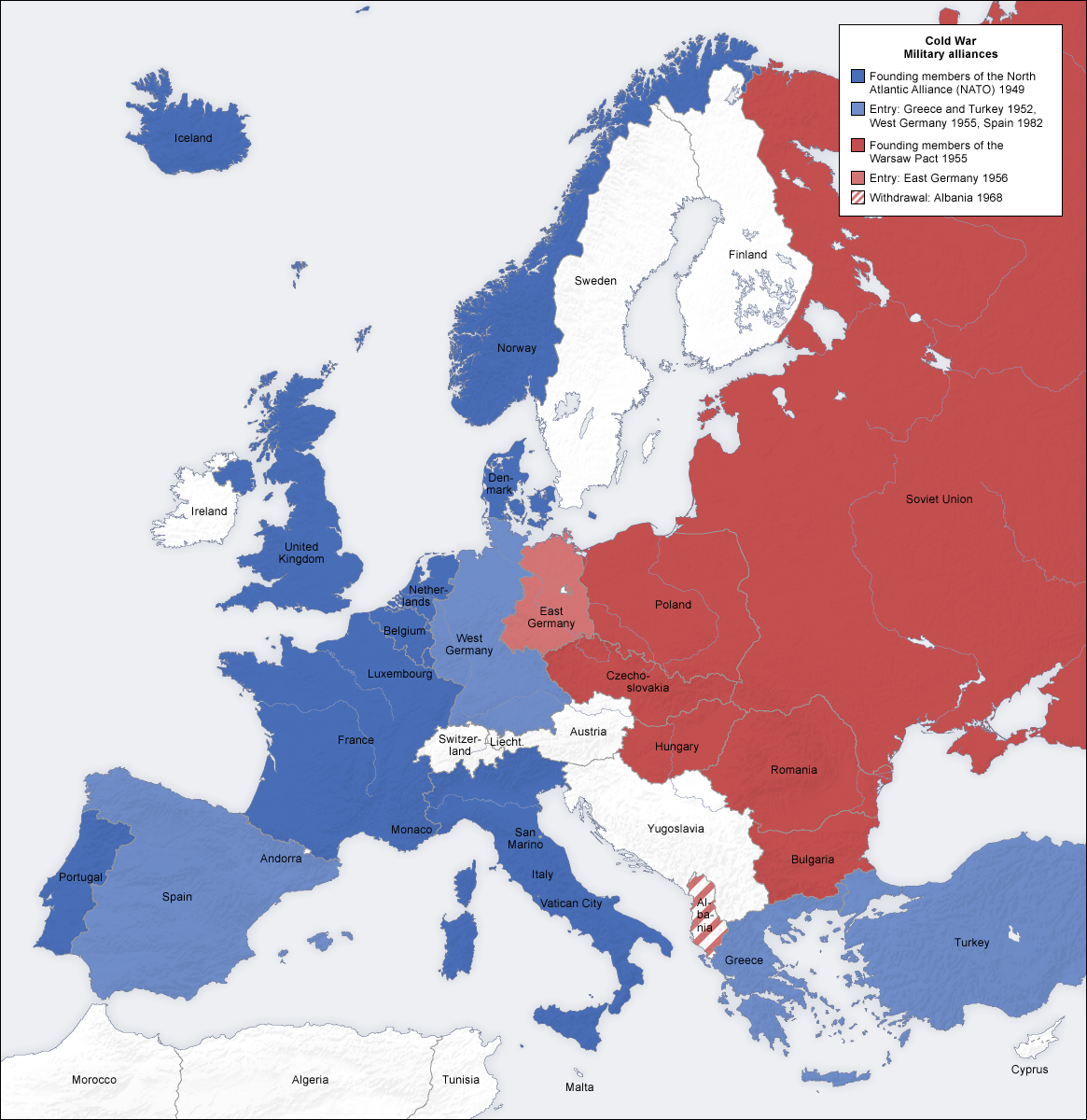
In April 1949, as Cold War tensions rose, the US and other Western nations established the North Atlantic Treaty Organization, or NATO, which is a formal military alliance to guard against a Soviet attack. Members of NATO agreed than an attack on one member would be considered an attack against the entire group. In response, the Soviet Union and the satellite nations of Eastern Europe formed their own alliance, the Warsaw Pact, in 1955.


The Shocks of 1949

Until 1949, most Americans were confident that the US was safe because it alone knew how to build the atomic bomb. However, in September 1949, the Soviet Union exploded its own atomic bomb. Now, the Cold War seemed much more deadly. Each nation had, within its reach, the power to destroy one another.

Shortly after, Americans received a second shock. Since the 1930s, China had been a battleground between the Chinese Nationalists and the Chinese Communists. In the final months of 1949, the Nationalist government collapsed. China fell under the control of the Communists. Under their leader, Mao Zedong, the Chinese Communists established the People’s Republic of China. The Chinese Nationalists fled to the island of Taiwan. The US insisted that the Taiwanese government was the legal government of China. It refused to recognize the People’s Republic and kept the UN from admitting Communist China to China’s seat on the Security Council.


I think this is a good place to stop for now. Next time here on the blog, we're going to talk about the prosperity of the post-WWII era. Not everything during the era of the Cold War was scary, after all!

I'm Back!

Hello readers! I'm so sorry for the long hiatus, but I've had a lot of changes happen in my personal life and I didn't have enough time to sit and write blog posts for a while; also during this hiatus I've been experimenting with podcasting, and that went really well. I'm hoping to be able to balance my time between work, being an author, being a podcaster, and blogging so I can get everything done that I want to!

I would like to thank each and every one of you for sticking by me throughout these changes. I know I've gone on hiatuses throughout the 11 years I've been writing on this blog, but I want to make a promise that I'll do better to not just disappear again.

That being said, for those of you so inclined, you can follow me on Instagram @mariedanielleannettewilliams to see what I've been up to when I'm not writing on this blog!

Thank you all again so much for your support!

Tuesday, August 24, 2021

German Espionage in World War II

Image: The 33 Convicted Members of the Duquesne Spy Ring; public domain


Hello readers. It's been a while since I last posted an actual post here on the blog, so I'm excited to get back into the swing of things. Previously, we were examining espionage in WWII, and that's where we're going to continue. 


The Abwehr 

After WWI and the signing of the Treaty of Versailles, Germany was prohibit­ed from establishing an intelligence or­ganization of their own; in 1920, the espi­onage group Abwehr was formed within the Ministry of Defense. In 1929, under General Kurt von Schleicher, the individual military services' intelligence units were combined and centralized under the Ministry of Defense. The Abwehr would become the German military intelligence service for the Reichswehr and Wehmacht from 1920 to 1945. 

Abwehr stations dotted Germany, with each station in an army district. As the Reich expanded, more offices were opened in occupied territories and in neutral countries. In 1935, the Ministry of De­fence was renamed the Ministry of War and then was replaced altogether by Adolf Hitler with the Oberkommando der Wehrmacht (or OKW). The OKW was part of Hitler's working staff from June 1938 to 1945 and the Abwehr became its intelligence agency under Vice Admiral Wilhelm Canaris; both the Abwehr and OKW were headquartered in Berlin.

During the early years of the war under Vice Admiral Canaris, the Abwehr expanded and proved to be efficient with its most notable success having been Operation Nordpol. Oper­ation Nordpol was an operation against the Dutch underground network. The Abwehr also collected information on both Denmark and Norway, observing Danish and Norwegian shipping ports and successfully infiltrating their militaries, which provided the Luftwaffe with valuable information during the invasion of Norway. Abwehr operatives helped broker arms-for-oil deals, and also played on the Romanian's fears of the Soviet Union and promised the Romanians protection in exchange for cheap oil.

The early successes of the Abwehr contrib­uted to the overconfidence of the German military. Early assessments by the Abwehr of the Soviet Red Army were low and it was de­termined that the German military would attempt to invade the Soviet Union; however, it was later determined that the Abwehr underesti­mated their enemies and overestimated their own capabilities, as the German invasion of the Soviet Union would fail due to a lack of supplies and an especially harsh winter.

The Abwehr was also present in the North African theatre. In 1940, Italy declared war as an ally to Germany and invaded Egypt and Libya. An Italian of Jewish heritage was re­cruited by the Abwehr and was sent to Egypt to report on any British operations; unknown to the Germans, this individual had already been working for British intelligence prior to the outbreak of the war and passed along hundreds of MI5 doctored messages to German intelligence, which aided in the successful surprise Allied landings in North Africa.

Vice Admiral Canaris made the United States a primary target for Abwehr agents even before the US entered the war. Abwehr agents infiltrated aluminum plants and other manufacturing plants in the hopes of gathering information about US war produc­tion means. Many of these agents were discovered; some were executed while a number went on to be double agents working for the US and sending falsified information back to Germany. Even Vice Admiral Canaris, who was losing confidence in Germany's ability to win the war early on, would pass false information to Hitler to prevent invasions Canaris knew would be unsuccessful. Still, the Abwehr powered on throughout the war but not without suspicions.

Some Abwehr members were opposed to the Nazi regime and communicated with Ameri­can officials, which included passing along in­formation about the existence and locations of concentration camps as well as information that was used to carry out Operation Overlord (also known as the D-Day Invasion). Due to the suspicious activities, Hitler's SS began to closely monitor the Abwehr and investigated its officers.


Duquesne Spy Ring

The Abwehr was not the only agency gathering and sending intelligence to the German cause. In the early 1940s, the Duquesne Spy Ring was uncovered as having infiltrated the US before the US had even fired a single shot in the war. 

The Duquesne Spy Ring was the largest espionage operations case in the United States. The Duquesne Spy Ring was run by Frederick Joubert Duquesne, a South African who became a naturalized American citizen in 1913. The ring was established to gather infor­mation that could be used if the US was to enter the war; the ring was intended to find holes in American military forces and preparedness as well as to destabilize the country and its morale via domestic terrorism, sabotage, and espionage. William Sebold, a German native who became a naturalized US citizen in 1936, was recruited for the spy ring while visiting his elderly mother. Sebold was questioned about his knowledge of military planes and equipment. Multiple visits by German Secret Police prompted Sebold to agree to be a spy rather than put his family at risk. 

Sebold discovered that his passport was stolen and went to the US Consolate to get a replacement; while there, he quietly spoke with an official and said he wanted to work as a double-agent. Under the guise of Harry Sawyer, Sebold was given espionage training by the Germans and was set up with a home and office in New York City by the FBI. Sebold met up with several members of the spy ring, including Duquesne.

Busting the spy ring was an intricate process. The FBI set up Sebold's apartment and office with hidden microphones, two-way mirrors, and an elaborate short-wave radio transmitting system. Duquesne passed along information related to sabotage possibities in industrial and weapons manufacturing plants; another agent passed along information, and explosive devices to Sebold.

Through Sebold's efforts, the FBI gathered enough evidence to arrest and convict all of the spies before they could carry out any of their plans.


Operation Pastorius

In June 1942, the Abwehr staged
a plan for sabotage inside the US, code named Operation Pastorius after Francis Daniel Pastorius, the leader of the first organized: German settlement in America.

After the attack on Pearl Harbor and Germany's declaration of war on the US days later, and the US response of declar­ing war as well, Hitler authorized a mission to sabotage the American war effort and attack civilian targets.

Eight German residents who had been living in the US were recruited by the Abwehr and were given three weeks of intensive training at an estate at Quenz Lake near Berlin. The agents, two of which held Ameri­can citizenship, were trained in the manu­facture and use of explosives, incendiaries, and primaries as well as the manufacture and use of mechanical, chemical, and electrical delayed timing devices. The agents were given extensive false personal histories and were encouraged to read American newspapers and magazines to keep up with current events and to improve their English speaking skills. The agents were given fake birth certificates, social security cards, driver's licenses, and draft deferment cards with their assumed aliases as well as $175,000 before they landed on the East Coast.

The agents' mission was to sabotage various targets that would bring both ec­onomic hardship as well as would slow America's wartime production. The targets included but were not limited to: hydroelec­tric plants, aluminum manufacturing plants, and more. The agents were to plant their explosive and incendiary devices at various bridges, canal locks, railroad stations, water plants, electrical plants, and public places to create wave after wave of terror among the American citizenry.

Operation Pastorius was at risk of failure before it had even begun-one agent left sensitive documents on a train and another, while drunk, bragged about being a secret agent. When four of the eight agents landed at what is today Atlantic Avenue Beach on Long Island, NY in June 1942, they were dis­covered by a Coast Guardsman as they were burying their uniforms and devices; the agents attempted to bribe the Coast Guardsman, who feigned cooperation and reported the incident, and a manhunt for the agents began. The second team of four landed without incident near Jacksonville, Florida. The two teams of agents were supposed to convene at a hotel in Cincinnati, Ohio to go over their plans for sabotage.

Two of the agents, George John Dasch and Earnst Burger, met in Dasch's hotel room where they confessed neither of them in- tended to go through with the mission; Dasch abhorred Nazism and planned to report the oper­ation to the FBI, and Burger planned to defect to the US immediately.

On June 15, 1942, Dasch made a phone call to the New York office of the FBI to explain who he was and why he was making contact, but the agent who answered the call was skep­tical of Dasch and disconnected. Four days later, Dasch arrived at the FBI building in Washington DC, where he brought evidence of the operation, and turned himself and the other agents in, unbeknownst to everyone except Burger and himself. Over the next two weeks the eight agents were arrested, with FBI Director J. Edgar Hoover taking full credit for the fall of Operation Pastorius.

The eight agents faced trial via a military tribunal from July 8, 1942-August 1, 1942. All eight agents were found guilty; six were sen­tenced to death by electric chair on August 8th; Burger received life imprisonment and Dasch received a 30 year sentence for turning them­selves in and providing information on the others and the operation.

The failure of Operation Pastorius led Hit­ler to reprimand Vice Admiral Canaris and the Germans did not attempt to carry out further sabotage plans from within the US.


Next time on the blog, we're going to examine the postwar era, moving ever closer to our present day!

Friday, July 30, 2021

The History Things Podcast

Hi everyone! It's been a while since I posted here on the blog, but I wanted to share something with all of you. I was a guest speaker on The History Things Podcast, where I had the opportunity to talk about the Revolutionary War in Upstate New York. You can listen to that episode here: The History Things Podcast.


I'll be back soon with another post, leaving where we left off with espionage in World War II!

Thursday, May 6, 2021

Action in the Adirondacks and Lake Champlain

Hello readers! On April 27th I was a guest on History Author Talks where I had the opportunity to talk about my book. Here's a link to watch the video!

Friday, April 23, 2021

Special Upcoming Event!!


Hello everyone! I just wanted to write this quick post to let everyone know that I'll be doing a special event on Tuesday, April 27, 2021 from 7-8pm EST. Author and historian Jack Kelly and I were invited to talk about our books and the significance of our research. To sign up for this free Zoom event, follow the link here: https://www.historyauthortalks.com/. I can't wait to see you all then!

Sunday, March 14, 2021

Espionage in World War II


Hello everyone. I'm sorry I've been MIA for so long. I've been busy with work and life. Let's jump right into things! 

Intelligence gathering, and what is done with the information, can turn the tide not just of battles but of entire war efforts. This post will examine how intelligence was gathered and utilized in WWI, and the individuals and groups who participated in acts of espionage. 

At the start of World War II the U.S. was lacking in a civilian agency dedicated to gathering foreign intelligence. That's not to say that the U.S. didn't participate in espionage-- the Army and Navy both had intelligence branches--but at the time those in charge of the federal government, including Henry Stimson who was President Franklin D. Roosevelt's secretary of war, believed that espionage was immoral. This belief left the U.S. at a disadvantage compared to Britain, Ger­many, and Russia, all of which had intelli­gence bureaus and spied on adversaries and allies alike.

With the attack on Pearl Harbor, the U.S. was forced to admit their shortcomings when it came to intelligence gathering and established the Office of Strategic Services (OSS), which would be a precursor to the Central Intelligence Agency (CIA). The OSS did more than just intelligence gathering; in addition to espionage, the establishment of the OSS paved the way for the formation of the U.S. military's Special Forces and also carried out paramilitary operations overseas. The OSS had several branches, including: Intelligence Services, which was composed of Secret Intelligence (SI), X-2, and Research Analysis (R&A), as well as Strategic Services Operations. SI officers recruited foreign agents; X-2 officers dealt with counterespionage and were tasked with combating enemy spies overseas; and R&A officers processed the intelligence received from SI. The Strategic Services Operations carried out missions where small teams of officers trained resistance fighters as well as committed acts of sabotage to cause destruction and mayhem.

There was a bitter rivalry between the OSS and the Federal Bureau of Investigation (FBI) in the U.S. in the 1940s. Under J. Edgar Hoover, the FBI's jurisdiction was expanded beyond North America into South America. As a consequence of this, the OSS wasn't allowed to operate in South America despite the knowledge of flourishing spy networks in various South American countries who were sympathetic to the third Reich. Not only was there a rivalry between the OSS and FBI, but the Army's G-2 and the Navy's Office of Naval Intelligence often refused to cooperate with the OSS; General MacArthur banned the OSS from areas under his command, as opposed to Gen­erals Eisenhower and Patton who recognized the benefits of the OSS and allowed OSS officers to play a role in the goings on in Sicily and North Africa.

According to the National World War II Museum in New Orleans, LA: "At its peak OSS staff numbered about 13,000 people, 35 percent of whom were women. About 7,500, both men and women, served overseas. OSS officers were given military status and rank with most assigned to the Army, however many were also assigned to the Navy and Marines. Many of these OSS Marines were assigned to the European theatre."

The OSS had a short life span, lasting only three years and three months, but it had a lasting impact. In 1947, the CIA was officially established and one-third of the CIA's personnel were former OSS officers, including four of the Agency's directors. OSS veterans led the CIA through the Cold War era: and the US Army Green Berets and the Navy Seals can both trace their roots to the OSS, to the Strategic Operations and Maritime Unit, respectively.

Next time on the blog, we're going to start taking a more in depth look at espionage in WWII.

Friday, February 12, 2021

Update!


Hello everyone! It's been so long since I posted on here. I've been going through a lot of life changes lately but I just wanted to let everyone know that I'm still on the history grind. I'm working on several projects right now--a second pitch for The History Press/Arcadia Publishing, a historical fiction romance story, researching for this blog, and I'm going to be starting a podcast called "The Half-Pint Historian Podcast" which I hope to have the first few episodes available in March to share with everyone! I'm also very active on social media. You can follow me at the below site to see what I've been up to:

Instagram: @mariedanielleannettewilliams

Friday, December 25, 2020

Taking a Break


In the fall of 2010, when I was just 19 years old, I had the opportunity to interview one of my favorite living authors, Stephen Elliott (The Adderall Diaries), for my college's newspaper. The final question I asked in the interview was "If you could tell people who want to be writers one thing, what would it be?" Stephen Elliott's response to my question was, "That they should focus on all the good things about writing and remember why they started writing. You have to do it for the art and if you lose sight of that, you'll be unhappy. If you focus on all of the good things about writing and why you love it, then you'll be happy." 

A decade later, I'm a writer in my own right with four published books, a poem, two short stories, and several articles and research papers under my belt, not to mention my blog, which has grown increasingly popular in recent months. I've basically been writing nonstop for the past decade; and I'm making the difficult decision to pull away for a while and take a break from it. I've been feeling stressed out and burnt out recently, so I decided to take a break from writing for a while so I can recharge my battery. At this point, I don't know how long the break will last. I'll still be active on social media and will promote my already finished work(s), but I'm pressing pause on my current projects. 

Thank you everyone for your support at this time.

Saturday, November 21, 2020

African Americans in World War II


Hello readers. It's been quite a while since I last wrote and published a blog post. With­out going into too much detail, I've recently made some career changes and have been going through some stuff in my personal life, but I'm back and ready to continue writing about American history!

As a primarily social historian who utilizes the bottom-up approach, I believe in the importance of everyone's story being told and in the importance of highlighting the commonalities and differences each group faced in a given period. This post will examine the experiences of Black Identifying People of Color (BIPOC) during the World War II era. 


African Americans served in every theater of World War II while struggling with segregation and other civil rights issues at home and abroad. In 1941, fewer than 4, 000 African Americans were serving in the US armed forces, but by 1945 more than 1.2 million African Americans would be serving in every branch of the armed forces.

During the war years, the segregation practices that plagued the civilian lives of African Americans on the home front would spill into military life as well. The draft was segregated, and BIPOC recruits were more often than not passed over by the all-white draft boards. The National Association for the Advancement of Colored People, NAACP, pressured President Roosevelt to pledge that BIPOC would be enlisted according to their percentage of the population; because of this, BIPOC enlistment increased during the war.

Initially, BIPOC serving at the beginning of the US's involvement in the war were assigned to non-combat units and served in support roles such as supply, maintenance, and transportation; these non-combat support roles were vital to the war effort. As troop losses increased, the military was forced to place more BIPOC troops in positions as infantrymen, pilots, tankers, medics, and officers.

During the D-Day Invasion, the First Army on Omaha and Utah Beaches included 1,700 BIPOC troops. The 1,700 BIPOC troops included a section of the 327th Quartermaster Service Company and the 320th Anti-Aircraft Barrage Balloon Battalion, which protected troops from aerial attacks; the all-black 761st Tank Battalion fought with Patton's Third Army, spending 183 days in combat and capturing 30 major towns and cities in France, Belgium, and Germany.


The Tuskegee Airmen

The US Army Air Force established several BIPOC fighter and bomber groups, including the famous Tuskegee Airmen of the 332nd Fighter Group, which became part of the 15th Air Force.

The Tuskegee Airmen flew ground support missions over Anzio and escorted bombers on missions over Southern Italy. The Tuskegee Airmen flew more than 15,000 sorties between May 1943 and June 1945.


Jackie Robinson

Before he became famous for breaking baseball's color barrier upon being signed with the Brooklyn Dodgers, Jackie Robinson served in WWII...and in 1944, a then-25-year-old Lieutenant Jackie Robinson would be court martialed for refusing to give up his bus seat in the Jim Crow South.

In a 1984 article for American Heritage Magazine, author Jules Tygiel (who wrote Baseball's Greatest Experience--Jackie Robinson and His Legacy) wrote about Robinson's court martial.

On July 25, 1944 Jackie Robinson boarded an Army bus at Fort Hood, Texas with the light-skinned wife of a fellow black officer. Robinson and the officer's wife were talking amicably and sat together on the bus; the bus driver, seeing a black man and a woman who appeared to be white, yelled to Robinson to move to the back of the bus. Rob­inson ignored the driver's order, which would lead directly to his court martial.

Robinson was to go overseas with his battalion, the 761st Tank Battalion, but was on limited service due to an old ankle injury. Robinson had to get his ankle examined before getting approval to go overseas. The medical exam took place at a hospital 30 miles away from Fort Hood; while waiting for the results, he got a pass to visit his battalion but discovered they were out on maneuvers, so he went to the officers' club where he met Mrs. Gordon H. Jones, the wife of another black lieutenant. Mrs. Jones lived on the way to the hospital where Robinson had to go, so they boarded the bus together.

Military buses, and Army posts in general, were desegregated at the time Robinson was ordered to, and refused to, move to the back of the bus. Robinson told this to the driver and he backed down until they reached the end of the line. While Robinson and Mrs. Jones waited for a second bus, two military policemen arrived on the scene and suggested that Robinson explain the situation to the provost mar­shal; Robinson was taken to military police headquarters where he was met with hostility and blatant racism. He was questioned about the incident and the MPs who were present said Robinson had an attitude; they questioned done if the white passengers on the bus and at the bus station but they refused to question Mrs. Jones about her version of events. Robinson was charged with insubordin­ation, disturbing the peace, drunkenness, conduct unbecoming of an officer, insulting a civilian woman, and refusing to obey the lawful orders of an officer.

Robinson's court martial took place on August 2, 1944. After deliberating, the nine judges found Jackie Robinson not guilty of all the charges that were brought up against him, and in 1946 he would go on to join the Brooklyn Dodgers, integrating the team.


Racial Struggles at Home

After WWII officially came to its end in September 1945, BIPOC soldiers returned home and faced racial discrimina­tion, sometimes in the form of angry white mobs who viewed the returning GIs as a threat to the social order they had grown accustomed to under the Jim Crow segrega­tion laws.

Not only were BIPOC soldiers met with violent acts of racial bigotry, BIPOC servicemen and women were often denied benefits guaranteed under the GI Bill that their white counterparts received, such as low interest mortgage rates on houses, tuition assistance for college and trade schools, job placement, and more. BIPOC veterans and civil rights organizations such as the NAACP protested the racial disparities experienced by BIPOC servicemen and women in utilizing the GI Bill's benefits.

According to Erin Blakemore, a journalist writing for history.com, "The original GI Bill ended in July 1956. By that time, nearly 8 million World War II veterans had received education or training...But most Black veterans had been left behind."


African Americans served in every military branch and every theater during WWI, and faced discrimination abroad and on the homefront that would help to move the civil rights movement forward in later years.


Next time on the blog, we'll examine various acts of espionage during WWII.


Thursday, October 1, 2020

Women in World War II

Women have always played a role in history, whether it be at the sidelines or in the forefront. In the period of World War II, women were increasingly beginning to take risks and step out into the public sphere, and women were even joining the military so they could serve their country. World War II historiography often ignores the women who did their part to lead to an American victory; the American public is taught about how women went to work in factories to produce war goods, and are taught very little else about women during this time period. However, women were just as patriotic as men, and many were just as willing to lay down their lives for their country.

World War II began with the German invasion of Poland in 1938; in December 1941 after the bombing of the U.S. naval base at Pearl Harbor in Hawaii, the United States would declare war and enter as an ally to Britain and France beginning with fighting in the Pacific. Men were called to fight, and women wanted to join the fray as well, and would enlist in various capacities. The most famous military organization for women to join was the WAAC, the Women's Army Auxiliary Corps. As an auxiliary unit, the WAAC served in a variety of positions in order to free up the men for combat; the WAACs served as telephone operators, secretaries clerks, typists, stenographers, cooks, and more . In 1943, according to Elizabeth M. Collins of Soldiers, the magazine of the U.S. Army, the WAAC became the WAC, the Women's Army Corps, and allowed women to become soldiers. The WAAC and the WAC played huge roles in the military, as they allowed women, white and black, to join the military and serve in various capacities. However, also according to Collins, the WACs were not afforded the same benefits as regular soldiers—if they were injured, they would not be given the same care as a soldier; and if they were captured they would not be given the same rights and protections as a captured soldier . In One Woman's Army: A Black Officer Remembers the WAC, by Charity Adams Earley, she wrote about her own experience in the WAAC and then in the WAC in the 1940s. She would become the first African-American commanding officer of a battalion (the 6888th) and the first African-American commanding officer of the WAAC. Although autobiographical, it was important to include this book in the historiography of WWII because it shows the human experience of the war; it also highlights some of what the African-American WAAC recruits experienced and had to deal with in regards to racism and discrimination in the military. Women in the military had to endure sex discrimination as well, as Collins discussed in her article in regards to women being treated differently than the male soldiers if they were injured or captured. These stories help to advance the historiography of women's roles and experiences in World War II. 

In her monograph To Serve My Country, To Serve My Race, Brenda L. Moore tells about the African-American women who served in the Women’s Army Corps (WAC) during World War II. Specifically, this monograph informs readers about the historic 6888th, which was the first African-American WAC to serve overseas. There were racial issues during the WWII era in the United States, and the U.S. government was pressured by the NAACP and other groups to deploy African-American women overseas to the European theater in 1945 along with their white counterparts; segregation was still prevalent in the U.S. military, so an all-black WAC regiment was created. The women of the 6888th served for many reasons, including patriotism and to challenge the system of racism they found themselves in; like other women who have served in the military in the past, sometimes disguised as men and sometimes not, other reasons for joining the WAAC and WAC included following a husband, brother, or father to war . The women of the 6888th served as postal directories in Birmingham, England, sorting backlogged and current mail to make sure the letters and packages arrived to where they needed to go. This was an important role to fulfill, as the letters and packages were addresses to soldiers, governmental officials, the Red Cross, and others; along with this fact, some of the generals realized the low morale of the troops who were not receiving letters from home due to this backlog and no one to process the mail. It was believed that it would six months or more for the backlogged mail to be sorted and sent where it was intended to go, but the 6888th would accomplish this feat in only three months, clearing over 65,000 pieces of mail every eight-hour shift . Many women in the WAAC and WAC enlisted to better themselves, particularly the women of the 6888th. Brenda L. Moore states that upon being sent back to the United States after the 6888th was no longer needed in Europe that many of the women remained in the active armed services; others immediately became a part of civilian life again; and everyone believed that their service in WWII would lead to such opportunities as education, full-time employment, and health case as a result of defending the U.S. Constitution . The WAC as a whole would be disbanded in 1978 when women in the U.S. Army would be integrated with men in all but the combat positions . 

The works of Charity Adams Earley, Brenda L. Moore, Judith A. Bellafaire, and others help to establish the importance of the WAAC/WAC and the 6888th in American history, and even in world history. Women have had a major impact of World War II, and the works of these women highlight the importance of women in the military at a time when it was sorely needed. Each of these works contributes to the historiography of women's history, gender history, and military history by highlighting the stories of people who are often left behind in the catacombs of the past.

Women in the U.S. military in World War II had more options than becoming a WAAC or WAC, women could also become WASPs. In The U.S. WASP: The Trailblazing Women Pilots of World War II by Lisa M. Bolt Simons, Simons writes about the women pilots during World War II. These women flew military aircrafts in non-combat situations, which freed up male pilots for military service. Although the purpose they served was for a non-combat role, these women played an important role in the ferrying of aircrafts and cargo from base to base, and their job could be dangerous nonetheless. The Women's Airforce Service Pilots (WASP) was founded to free up more men for combat positions, similar to the founding of the WAAC and later the WAC, as well as notable positions in the military. The WASPs ferried airplanes from base to base, dropping off packages and mail, and other tasks that required the use of flight for time constraints. The U.S. military realized that there were not enough men to become pilots as was needed, but two women pilots, named Jackie Cochran and Nancy Harkness Love, knew that women were capable of flying planes just as well as men were and founded the WASPs . In 1941, Jackie Cochran went to First Lady Eleanor Roosevelt to volunteer her services and to request that female pilots serve in the war effort if the U.S. was to enter the war; Roosevelt loved the idea, but the U.S. military was not ready for it; Cochran also went to General Henry Arnold twice, who told her to ferry planes in Britain, she took his advice and brought 25 women with her . As a result of this small corps of pilots, women pilots would be welcomed into the military; serving in various non-combat air force roles. The WASPs were not treated the same as male military pilots were—there were no benefits of education or employment, and if they were killed while ferrying ships in the U.S. or in Europe, they had to pay to have their bodies returned home which was something the men did not have to do. Simon's work highlights the important role these women played in World War II, and it add to the historiography of women's history and military history because these women were forgotten in history and history needs to know the story of these brave women. 

Women had had a hand in wars in the United States even as the United States was fighting to become its own nation, separated from English rule. Women played roles in the American Revolution, the Civil War, and World War I, so women playing roles in World War II should come to no surprise. Women loved their country just as much as men did, and the women of the WAAC and the WAC were all volunteers; they were not drafted into the war effort as many of the men were but were there willing for various reasons. Some women traveled to the European Theater of the war and worked there to fulfill the WAAC and WAC roles previously mentioned, some were sent to the Pacific Theater, and some remained on the home front and served with the National Guard. However, women did more than serve in the WAAC and the WAC. Women also played a role in espionage. 

Espionage played a huge role in World War II, and often women were at the forefront. From code breaking to parachuting into enemy territory and working as a spy, women worked to advance the war effort from behind the scenes. Code Girls: The Untold Story of the American Women Code Breakers of World War II by Liza Mundy describes the experiences endured by the women codebreakers, cryptographers who intercepted and translated coded messages from the Axis Powers and others who meant to do harm to the Allied Powers. The young women that were sought after to be code breakers were well-educated—usually in their early-20s and graduated from the top colleges in the country; others were school teachers who were well-versed in various subjects; others were very skilled in various secretarial roles; and others were able to speak, read, and write multiple languages—which contributed to why they were chosen to be the code breakers. The code girls were recruited from the "Seven Sisters" colleges  (including Mount Holyoke, Barnard, Smith, Vassar, Bryn Mawr, Wellesley, and Radcliffe), and code breaking would make advancements during this war, as women in the United States and men and women in Europe trained in their colleges on how to intercept and break codes. These advancements that the first group of code girls made in intercepting and breaking the codes used by the Axis Powers. Mundy wrote this book using interviews she was able to get with some of the code breaking women. A good source of information for anyone who wants to learn more about the many roles women played in World War II, it highlights the efforts of women who remained in the home front during the war and what they were able to accomplish. The female code breakers were recruited by government officials in Washington, D.C., and their positions would eventually be traded from the U.S. government as an entity to the various branches of the military. Mundy's work shows how this secret army of women helped to advance the war effort and helped to bring success to the Allied Powers.  

The women code breakers worked behind the scenes, so to speak, to advance the war effort, but other women were not happy to work behind the scenes and became spies. In American Women Spies of World War II by Simone Payment, she describes the lives of several American women who became spies for the Allied Powers. The U.S. did not initially want to establish a spy network, trusting in its allies to pass along any information that was necessary to share, but with the intricacies and imperativeness of the war, the U.S. found it was necessary to establish a spy network during World War II, and would establish the Office of Strategic Services in 1942 . Payment writes about the women of the OSS, some are well-known even by today's standards, and some have been previously unknown but their stories were found by digging in archives and special documents. Some of these women include: Virginia Hall, Claire Phillips, Aline Griffith, Elizabeth "Betty" Pack, Josephine Baker, and Mary Bancroft. Of these women, two are amongst the well-known, and they are Virginia Hall and Josephine Baker. Virginia Hall was known as the "Limping Lady" because she had an artificial leg. She had lived in Europe after attending college, where she studied French, German, and Italian, and operated behind enemy lines in Nazi-occupied France, after being recruited by the British SOE (their equivalent of the OSS) as an agent where she went undercover as a reporter for the New York Post . With this guise, she was able to spy on the German's activities and was able to pass along German movements and coordinate parachute drops. Josephine Baker was a famous dancer and singer in the 1920s and 1930s, and she would eventually move to France to perform; in France, she would become a member of a French resistance movement against the Nazi occupation where she would go so far as to hide messages in invisible ink on her sheet music. Both of these women, according to Payment and other historians, risked their lives to aid in the Allied war effort.

Women in World War were WACs, WASPs, and spies, but they still did more to advance the war effort by working on the Manhattan Project. The Manhattan Project was scientific research and development with the end goa to produce the first atomic bomb. In her book The Girls of Atomic City: The Untold Story of the Women Who Helped Win World War II, Denise Kiernan wrote about the women of Oak Ridge, Tennessee who were enriching uranium for the nuclear bomb, but their job was so secretive that even they did not fully know what they were doing. Oak Ridge was a town created in 1942, it did not appear on any maps until after World War II had ended, there were about 75,000 residents in the town, and it used more electricity than New York City. All around the town were signs with a patriotic image and a message reminding those who resided in the town to not speak about the work they were doing; signs like these were typical of the war period on the home front, appearing in towns and cities all around the United States. Denise Kiernan interviewed ten women who worked at Oak Ridge during World War II and conducted extensive research to be able to tell about the women with secret jobs in a secret town. In Oak Ridge, the men and women there felt like they were doing their part to bring the war to the end; the scientists and engineers directly involved with the Manhattan Project knew the work they were doing would bring the war to an abrupt end, but the women who left everything they had known to come to Oak Ridge took various positions in order to advance the war effort and their own careers in the fields they had studied for. The women of Oak Ridge, according to the overall point of Kiernan's book, worked for a variety of positions for the combined efforts of the government and the military in relation to the top-secret Manhattan Project—they worked as janitors, pipe inspectors, secretaries and stenographers, transcriptionists, statisticians, mathematicians, chemists, and physicists all under lead scientists who would eventually invent, test, and deploy the two atomic bombs that would bring the Second World War to its end—the Gadget and Little Boy. Denise Kiernan, in partnership with Simon & Schuster, the publishing company for The Girls of Atomic City, made a video on YouTube where she talked about some of the details that both were and were not mentioned in her book; one point she drives home throughout the book is how secretive the work being done in Oak Ridge was, stating numerous times that the women involved knew what their jobs were but did not know what the over-encompassing project was. Denise Kiernan writes about several women throughout her book and their experiences with how secretive the project was. One such woman was Celia Szapka, who was a secretary for the Manhattan Project first in Manhattan and then in Oak Ridge. Readers are introduced to Celia as she's on a train on her way to Tennessee. As she looks out her window, she has one question: "Where was she going? Already many hours long, Celia's trip felt more endless because her final stop remained a mystery" . For the women like Celia, the project was so secret they did not even know they were going to a new town that would be given the name of Oak Ridge. Originally from Shenandoah in Pennsylvania, Celia was described by Kiernan as someone who was always up for an adventure, and her trip to Oak Ridge was not the first trip she made for a job where she was unsure of exactly what she would be doing. Celia left Pennsylvania for work in Manhattan as a secretary before taking the job in Oak Ridge. One quote that sticks out the most in regards to Celia's introduction in the book is, "She quickly learned that all the women on the train had been told that their new jobs served one purpose only: to bring a speedy and victorious end to the war. That was enough for her" . For some of the women who were making their way to Oak Ridge, they were unconcerned with what they would be doing despite having questions about where they were going; they knew that their work would benefit the U.S. war effort, that their work would bring an end to the war, and knowing that was enough for them. However, in the aforementioned video, Kiernan states that the people of Oak Ridge did not learn the true nature of the project until August 6, 1945 after the bombing of Hiroshima, Japan . It was then that the women realized that they were enriching uranium and that they learned the purpose of what they had been doing. Despite the devastation the bombings of Japan wrought, the women, the people of Oak Ridge, did their part to bring an end to the war.

Finally, servicewomen served the war effort as battlefield nurses. In And if I Perish: Frontline U.S. Army Nurses in World War II by Evalyn Monahan and Rosemary Niedel-Greenlee, the authors describe the lives of the women U.S. Army nurses during World War II. These women voluntarily left their homes and left their colleges to serve as battlefield nurses; they served in Africa, Italy, France, and other war-torn areas where they were needed. Monahan and Neidel-Greenlee rely on interviews with veteran battlefield nurses in order to gain knowledge of their experiences during World War II, and there are bits and pieces of letters throughout the book from these women to various family members. Many of the nurses were young--in their late teens and early 20's, so their wartime experiences were some of their first experiences away from home. One such woman the authors write about is First Lieutenant Frances Nash, who was stationed in the Philippines. "When Nash and other army nurses arrived in Manila harbor in 1940, they looked more like debutantes than military nurses. They left the ship in chiffon dresses accessorized with matching or complimentary high heels, white gloves, and large-brimmed picture hats. Their trunks were free of khaki, since there was no military uniform for the military nurses of the day. Instead, they were packed tight with floor-length evening gowns, fashionable dresses for dinners and cocktail parties, as well as a range of outfits suitable for a variety of social occasions" . The women believed that the impending war would be swift, and they would see hardly any action. However, three hours after the bombings of Pearl Harbor, Japan attacked various army bases in the Philippines as well. As the military hospitals were close to the military bases where the Japanese were air striking, the army nurses were the first to arrive on the scenes, having run from the hospitals to the bases to perform their duty . On December 24, 1941, the nurses were being evacuated from Manila to Bataan; Nash was told by her commanding officer that she would be left behind with several others and would be evacuated at a later time, and to prepare to be captured if the Japanese moved on Manila quicker than the U.S. anticipated; while she remained in her military hospital, Nash destroyed papers she believed the Japanese would find valuable, until she and the others left behind were ordered to evacuate to Bataan as well . Monahan and Greenlee describe hospitals being attacked by Japanese air raids; they describe the nurses being sent wherever they were needed--be it Africa, Italy, or even the beaches of Normandy. Throughout their book, through reading about the women who served as army nurses and readings bits and pieces of their letters to hoe, the reader gets a sense of just how important these women were to the war effort. They worked to bandage up the wounded soldiers, they assisted the surgeons in the operating rooms, they ran onto the battlefields to collect the dead and dying and do what they could. These women risked their lives just the same as the men did, and did so knowing their families would not be awarded the same benefits for their deaths as the families of a male doctor or soldier would. 
  
The women of World War II, in particular the women who wanted to serve their country so much they joined the military or worked for governmental or military projects, were a special breed of women who are often left out of the narrative when it comes to the history of World War II; however, these were women who dedicated their lives to the war effort, and to try to ensure that the United States would be successful.

These historians and others who works are mentioned throughout this piece all worked to advance the historiography of women's history and military history by sharing the stories of the women who aided the American war effort in World War II. Although some of these sources were autobiographical, adding these sources into this paper was necessary because they also played a role in adding to this historiography of women's history and military history. History often forgets the women, and although General Henry Arnold promised once the WASPs were disbanded that the government (and history) would not forget them, the collective psyche of those who created U.S. and world history texts did forget about those women. All of the historians and the autobiographies utilized in this piece had played a role in advancing the historiography of World War II as a whole.


Bibliography

Collins, Elizabeth M. "20 Facts About the Women's Army Corps", http://soldiers.dodlive.mil/2016/05/20-facts-about-the-womens-army-corps/, accessed October 20, 2017.
Earley, Charity Adams. One Women's Army: A Black Officer Remembers the WAC (College Station: Texas A&M University Press, 1995).
Fargey, Kathleen. "6888th Central Postal Directory Battalion", (Center of Military History, 2014), https://history.army.mil/html/topics/afam/6888thPBn/index.html, accessed October 21, 2017.
Moore, Brenda L. To Serve My Country, to Serve My Race. New York: New York University, 1996.
Simons, Lisa M. Bolt. The U.S. WASP: The Trailblazing Women Pilots of World War II. North Mankato, MN: Capstone Press, 2017.
Liza Mundy, Code Girls: The Untold Story of the American Women Code Breakers of World War II (New York: Hatchett Book Group, 2017.
Payment, Simone. American Women Spies of World War II. New York: Rosen Publishing Group, 2004.
Kiernan, Denise. "History in Five: The Manhattan Project's Secret City", https://www.youtube.com/watch?v=JSf3GOMziOg, accessed November 1, 2017.
Monahan, Evalyn and Niedel-Greenlee, Rosemary. And If I Perish: Frontline U.S. Army Nurses in World War II. New York: Anchor Books, 2007.


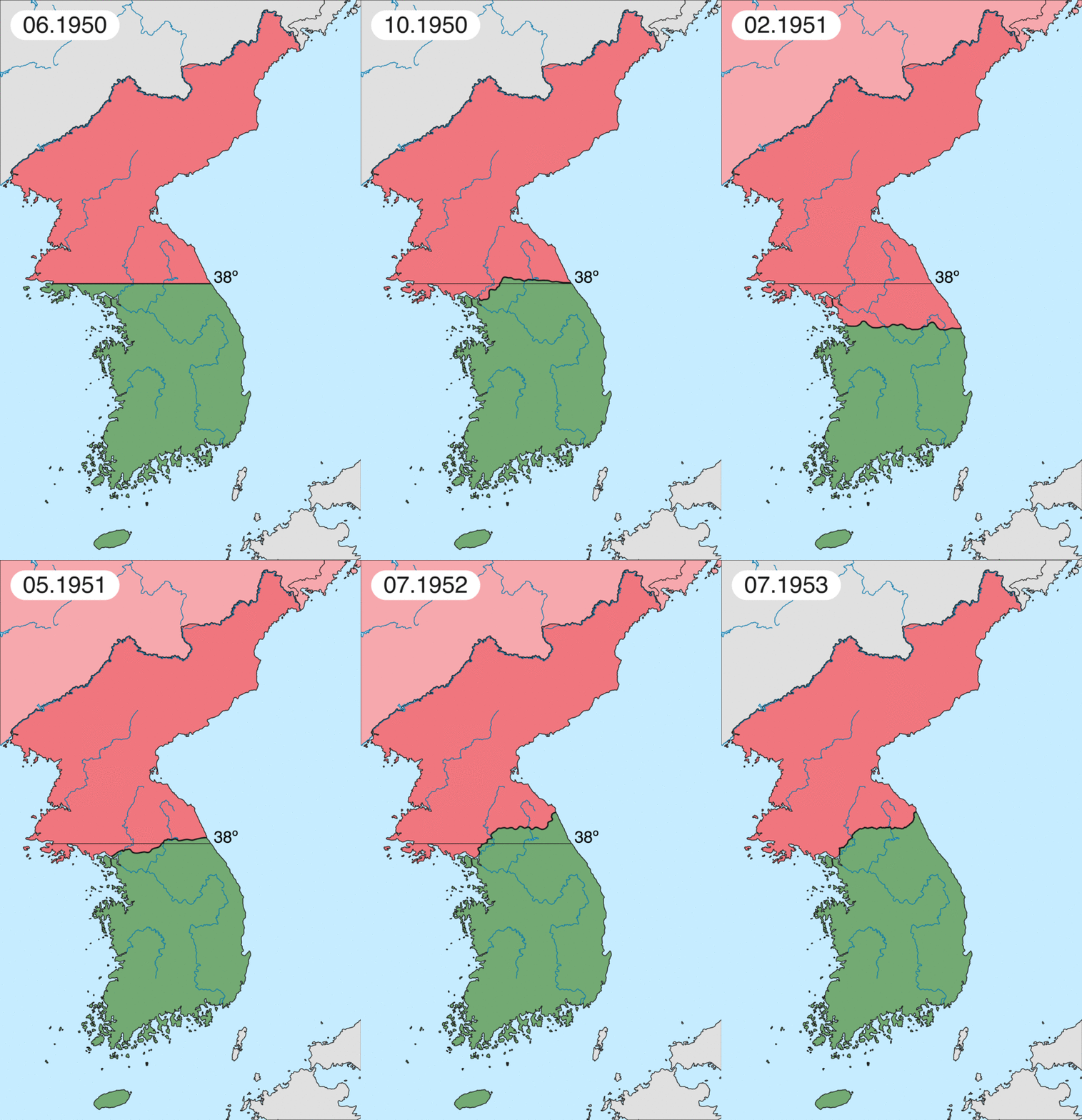
 

Global Concerns in the Cold War Part II

Hello readers! It's been a while since I last posted an update here on the blog. Since my last post, I submitted my second manuscript to...